In this article
Fix the page that should win your next customer before commissioning a separate “GEO strategy”. For most small businesses, the first useful work is the same: explain your offer, keep business information accurate, make important pages accessible and give visitors a working next step.
SEO means search engine optimisation. GEO, or generative engine optimisation, is a label for work intended to improve visibility in AI-generated answers. It is useful shorthand, but the label alone does not tell you which service, feature or result someone can influence. Ask that question before buying anything.
Use the search visibility checklist to assign the work below. It records actions and evidence; it is not a score that predicts whether an AI system will mention you.
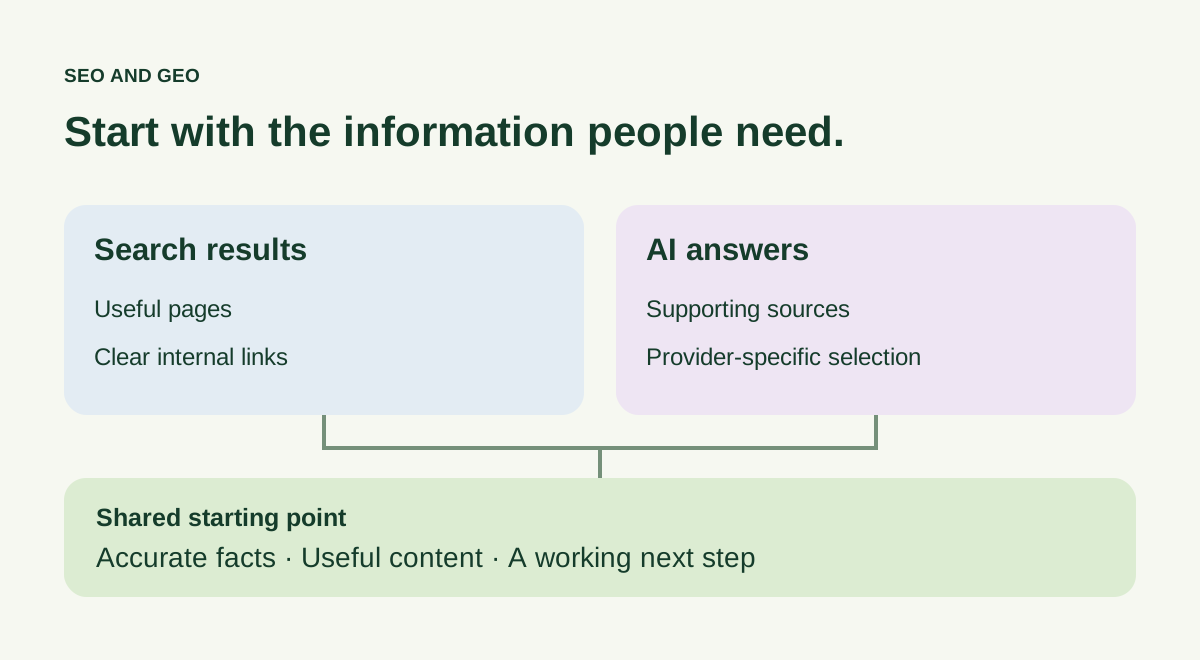
Three kinds of visibility to keep separate
A business can appear as a conventional search result, as a source in a Google AI feature, or in another provider’s answer. Seeing your name in one place does not establish visibility in the others.
| Area | What the customer sees | Useful work to prioritise | What remains uncertain |
|---|---|---|---|
| SEO for conventional search | A result linking to a page, sometimes alongside local or other search features. | Clear service pages, accurate local details, accessible content and a useful customer journey. | Your position for every person and query; a visible result does not prove a sale. |
| Google AI Overviews and AI Mode | An AI response that may link to supporting websites. | The same SEO foundations; no separate Google AI eligibility project. | Whether a particular answer will include your page. |
| Other AI services | An answer, recommendation or source link, depending on the service and mode. | Identify the specific provider, inspect its documentation and keep your public business information useful. | A universal selection formula; Google’s documentation cannot establish another provider’s behaviour. |
Google says SEO fundamentals apply to its AI features: pages need indexing and snippet eligibility, no special AI file or schema is required, and inclusion is not guaranteed. See Google’s AI features documentation. That is a reason to fix foundations before buying an extra technical layer.
Use the next-customer test to set priorities
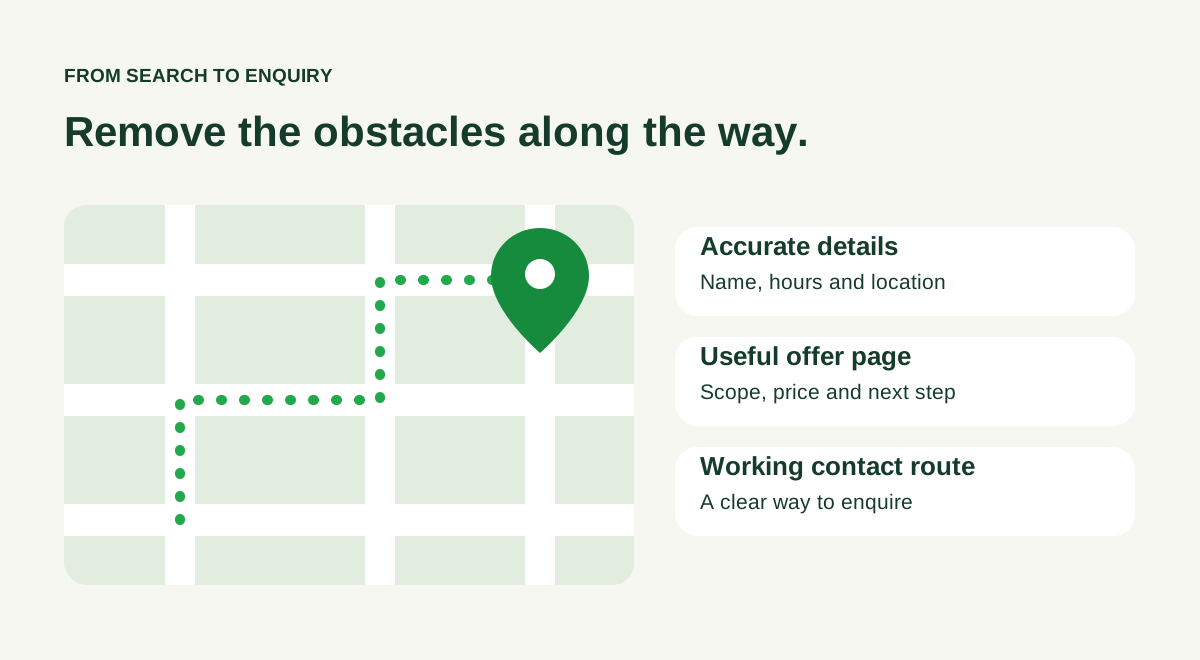
Imagine someone ready to enquire today. Which defect is most likely to stop them? Put that ahead of a speculative visibility tactic. The following order is our editorial framework for a small business with limited time.
- Repair wrong information and broken actions. A disconnected phone number or booking link wastes existing attention. Confirm prices, hours, location and the destination behind each main button.
- Make the main offer page understandable. Explain what you do, who it suits, where you operate, what is included and how to get a price. Resolve the questions customers ask before buying.
- Check whether important pages can be discovered. Link to them from relevant navigation and pages. Use available webmaster tools to investigate indexing problems rather than assuming a published URL is being found.
- Improve local information where relevant. Match your profile, website and actual operation. Google identifies relevance, distance and popularity as principal local-ranking factors in its local ranking guidance.
- Publish something worth consulting. Add an original checklist, clearly scoped comparison, worked example or explanation that helps a real decision. Expand from customer questions you understand.
For a local service, our Malaysia local SEO checklist develops the profile and service-page work. A national online shop may put product information and purchase friction ahead of neighbourhood details. The ordering follows the business.
What a useful answer page looks like
Consider a fictional air-conditioning service with a page headed “Air-cond servicing in PJ”. A thin version lists suburbs and repeats “professional, reliable service”. A useful version explains the residential jobs accepted, the real service area, how unit type affects the quote and what customers should send when asking for a visit.
Add the business’s actual preparation checklist: unit count, photographs of the units, postcode, access arrangements and preferred date. Explain which information is necessary for a quotation and which requires an inspection. A customer now has something they can use.
Organise that page around questions rather than keyword repetition. Put the direct answer close to each heading, then add the detail needed to act. Use a table only if it makes a comparison clearer. These are our recommendations for readability; they are not a guaranteed citation format.
Do not turn one useful page into fifty near-identical area pages. Google’s guidance on generative AI content warns against producing many pages without added user value. A new page should earn its place by helping with a distinct question.
A four-week plan you can assign
| Week | Do the work | Keep this evidence | Decision at the end |
|---|---|---|---|
| 1: Establish reality | Choose one important service or product. Check its page, mobile contact route and local details. Record available search and enquiry baselines. | Page URL, dated issues, screenshots and a simple enquiry count. | Which error is costing customers the clearest next step? |
| 2: Repair the buying page | Rewrite the offer explanation, add missing scope or price information, fix contact links and connect relevant pages. | Before-and-after copy and a completed mobile enquiry test. | Can someone unfamiliar with the business explain how to enquire? |
| 3: Add a useful resource | Turn one repeated customer question into an original checklist, example or comparison. Have the person who delivers the service review it. | The resource, its factual references and the reviewer’s corrections. | Does it help a customer do something they previously struggled with? |
| 4: Review and choose | Inspect available search data, page visits, enquiries and customer questions. Note any AI-answer checks with dates and exact prompts. | A change log and observations, including gaps in the data. | Which single improvement deserves the next month’s time? |
The month creates a working process, not a ranking deadline. If week one uncovers a serious indexing problem, resolving it may occupy week two. If customers still cannot tell whether you serve them, improve that explanation before starting a second guide.
Measure business progress without inventing an AI score
Google includes AI-feature traffic in Search Console’s overall Web reporting, as its measurement guidance explains. A rise in total clicks therefore does not isolate AI-answer visibility.
Keep three records: work completed, available discovery signals and business outcomes. Work completed might be a repaired form. Discovery signals might include search impressions and referred visits. Outcomes include suitable enquiries, bookings or orders. Keeping these separate lets you see useful progress without claiming every movement came from your latest edit.
An occasional AI-answer check can reveal a wrong business description or a source worth investigating. Record the provider, prompt, date and linked pages. Treat the observation as a snapshot. Spend more time fixing an incorrect service detail than repeatedly asking slightly different questions until a mention appears.
Give the next improvement an owner and a review date using the visibility checklist. Then explore Upside’s Search & Visibility sample to see website checks, search performance, local presence and reviews in one workflow.
Prepared by Upside. Sources are linked alongside the claims they support.
 Tools & decisions · 6 min read
 Marketing planning · 6 min read
 Search & visibility · 6 min read