In this article
If your marketing plan says “post three times a week”, the most important decisions are still missing. What business problem should those posts solve? Why would someone act? What happens when they reply?
A one-page marketing brief answers those questions before you spend time making content. It gives an owner, employee, freelancer or AI assistant the same instructions. Open the free printable brief, or download the three filled examples as a CSV. Start with one offer for one audience over a short review period.
What belongs in a one-page brief?
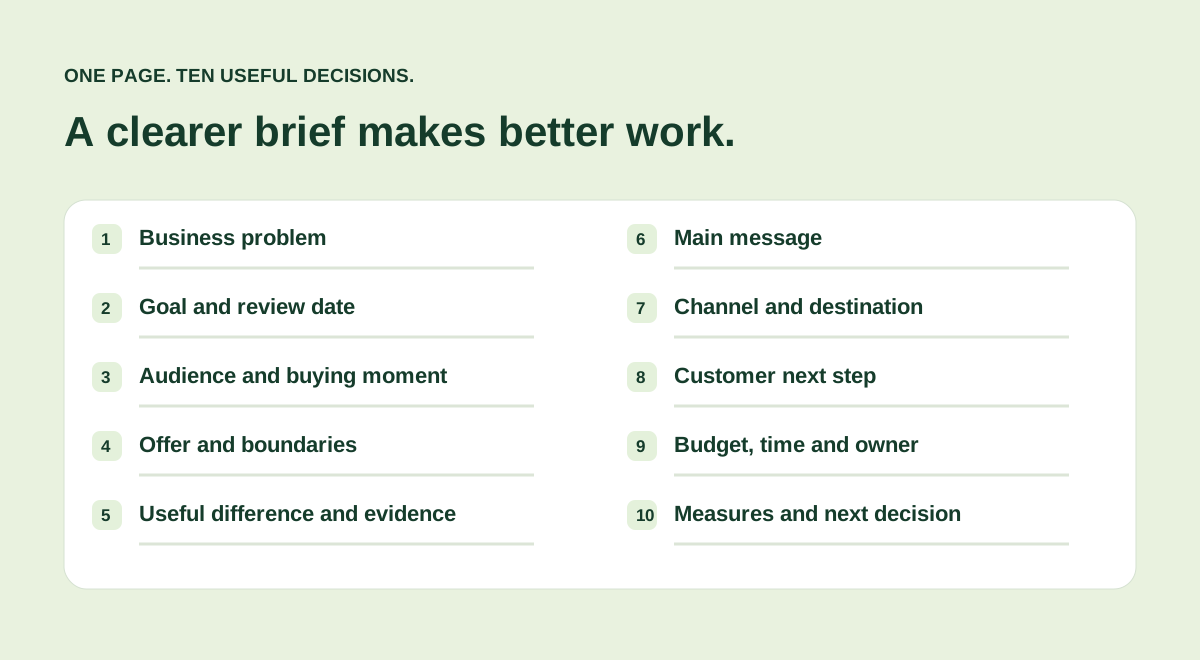
Use the ten fields below. A short, concrete answer beats a polished paragraph. Where a fact is missing, write the question that needs answering. The brief is ready when another person could explain the offer and handle the first enquiry without guessing.
| Field | What to write |
|---|---|
| 1. Business problem | The gap you can observe: empty slots, unsuitable enquiries or unsold stock. |
| 2. Goal and review date | A business outcome, a realistic target and the date you will review it. |
| 3. Audience and buying moment | Who needs the offer, and the situation that makes it relevant now. |
| 4. Offer and boundaries | What is included, price, dates, availability and any important exclusions. |
| 5. Useful difference and evidence | One reason to choose you, supported by something you can show. |
| 6. Main message | The single idea someone should remember. |
| 7. Channel and destination | Where the message appears and where the customer goes next. |
| 8. Customer next step | One specific action and the information needed to take it. |
| 9. Budget, time and owner | Cash cap, working time, responsible person and delivery capacity. |
| 10. Measures and next decision | What you will record and what the result will help you decide. |
Keep the problem separate from the goal. “Tuesday appointments are quiet” describes the situation. “Book six additional Tuesday appointments over four weeks” sets a target. Choose the number from your own capacity and recent demand; a template cannot choose it for you.
The examples below are fictional, including their names, prices, budgets and targets. They illustrate decisions, not recommended spending levels or reported results.
Example 1: A café makes office collection easier
- Business problem
- Pagi Café in Petaling Jaya has spare kitchen capacity before noon on weekdays.
- Goal and review date
- Receive 20 lunch-set pre-orders over a two-week test; review after the second Friday.
- Audience and buying moment
- People in nearby offices choosing lunch before their workday becomes busy.
- Offer and boundaries
- RM18 chicken rice bowl and iced tea; weekday collection, 11.30am–12pm; order by 10am; maximum 10 sets daily; no delivery.
- Useful difference and evidence
- A defined collection window; show the actual meal and collection counter.
- Main message
- Choose lunch before 10am and collect it before the noon rush.
- Channel and destination
- Existing Instagram account and counter card, both directing to the current lunch details page.
- Customer next step
- WhatsApp the date, quantity and name; staff confirm availability and payment instructions.
- Budget, time and owner
- RM80 printing cap, two preparation hours; owner creates material, cashier handles orders; stop at daily capacity.
- Measures and next decision
- Record confirmed sets, collection problems and food cost; decide whether the window and menu suit repeat orders.
The useful choice is convenience. A general “delicious lunch” post gives an office worker little to plan around. A collection window creates a concrete reason to respond. It also exposes an operational question: can the kitchen have every confirmed order ready then? Resolve that before designing the card.
Example 2: A salon promotes the slots it can actually fill
- Business problem
- Ruang Hair in Subang Jaya has six open Tuesday afternoon appointments each week.
- Goal and review date
- Fill six additional appointments across four Tuesdays; review at the end of week four.
- Audience and buying moment
- Existing followers who can arrange a weekday cut and want a clear starting price.
- Offer and boundaries
- RM65 wash and cut with a junior stylist, Tuesday 2–5pm; colouring and treatments excluded; booking required.
- Useful difference and evidence
- A clearly priced service and bookable weekday window; show representative cuts by that stylist.
- Main message
- A Tuesday cut with the price and appointment time agreed before you arrive.
- Channel and destination
- Instagram Stories linking to the appointment enquiry page.
- Customer next step
- Send the preferred Tuesday and time; receptionist confirms an available appointment.
- Budget, time and owner
- No paid-media allocation; 90 minutes for assets; receptionist updates availability each Tuesday morning.
- Measures and next decision
- Track enquiries, confirmed slots and attendance; decide whether timing or service details need changing.
This brief avoids discounting every service to solve a narrow scheduling problem. It also tells the team what to do when a slot fills. A reusable Story can change its availability line while keeping the offer consistent.
Example 3: A B2B service filters for a useful first conversation
- Business problem
- Meja IT receives vague support enquiries that take several messages to qualify.
- Goal and review date
- Book four suitable discovery calls over one month; review on the final working day.
- Audience and buying moment
- Office managers at small Klang Valley firms preparing to add or replace staff laptops.
- Offer and boundaries
- A free 20-minute discovery call for offices with 5–25 devices; advice on project scope, without a repair or security audit.
- Useful difference and evidence
- A structured preparation checklist; publish the actual questions used to scope a laptop rollout.
- Main message
- Bring your device count and move date; leave knowing what information a rollout quote needs.
- Channel and destination
- A LinkedIn post linking to a service page with the checklist and enquiry form.
- Customer next step
- Submit device count, office location, deadline and contact details to request a call.
- Budget, time and owner
- No paid-media allocation; three preparation hours; service lead takes at most two discovery calls weekly.
- Measures and next decision
- Record suitable enquiries, calls held and quote requests; decide whether the checklist attracts the intended projects.
Here the content earns attention by helping with a task. The checklist is useful before anyone purchases. Google’s people-first content guidance asks creators to consider original value. Publishing an actual scoping aid is our practical application of that principle.
Turn the brief into one manageable week
Use Monday to confirm the offer and complete the brief. On Tuesday, make one main asset and check its destination on a phone. Publish or distribute it on Wednesday, with someone assigned to replies. On Friday, record enquiries and outcomes, then choose one adjustment. Keep reply handling in the daily routine.
A slow response may explain lost bookings better than the headline. Several price questions may mean the offer page needs work. Avoid changing the audience, offer and channel simultaneously: you lose the ability to explain what you learned.
If you use Analytics, consistent campaign parameters can identify which links referred website traffic; Google explains them in its campaign URL guide. Pair that information with your enquiry record so a page visit and a confirmed order remain distinct.
Fill in your own printable brief and use the example CSV as a reference. Then explore the AI CMO sample to see how a goal becomes a plan and creative you can review.
Prepared by Upside. Sources are linked alongside the claims they support.
 Tools & decisions · 6 min read
 Search & visibility · 6 min read
 AI & business · 6 min read