In this article
“Elevate your everyday with our premium lunch experience. Quality ingredients, exceptional flavour, unforgettable moments. Order now!”
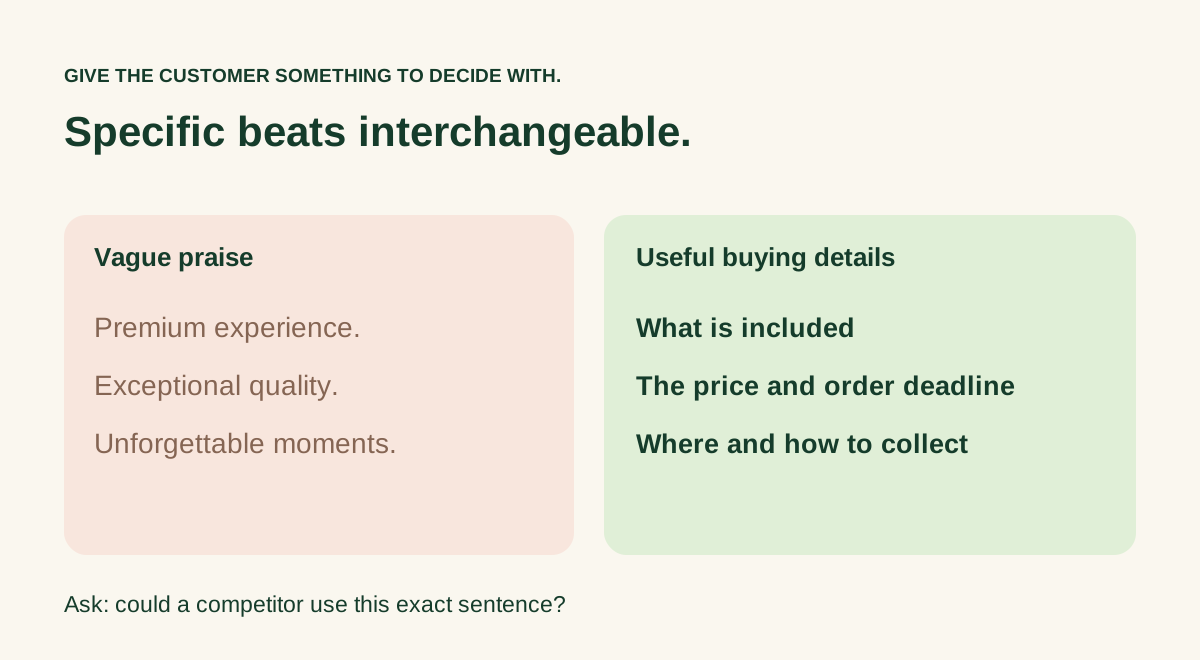
You could put that caption under a café lunch, a meal subscription or a hotel buffet. It gives a customer almost nothing to decide with. For a fictional café with a specific offer, compare it with: “Lunch sorted before your first meeting. Order our RM18 chicken rice bowl and iced tea by 10am; collect at Pagi Café, PJ, between 11.30am and noon. WhatsApp your date and quantity to check availability.”
The second version has a buying situation, an actual offer and a usable next step. Getting there starts with a better brief. Our recommendation: supply the business decision and the facts before asking AI for a more creative sentence.
The missing ingredient is often a decision
“Write an engaging caption for my café” asks a tool to supply the audience, offer, benefit and tone simultaneously. Even a fluent answer may land on broad praise because you have not supplied a specific reason for someone to buy.
Decide what this piece should do. Fill a collection window? Explain a new service? Reduce unsuitable enquiries? These require different messages. The same café might write about a quiet place to work in one campaign and a quick lunch collection in another. Putting both in one caption weakens the focus.
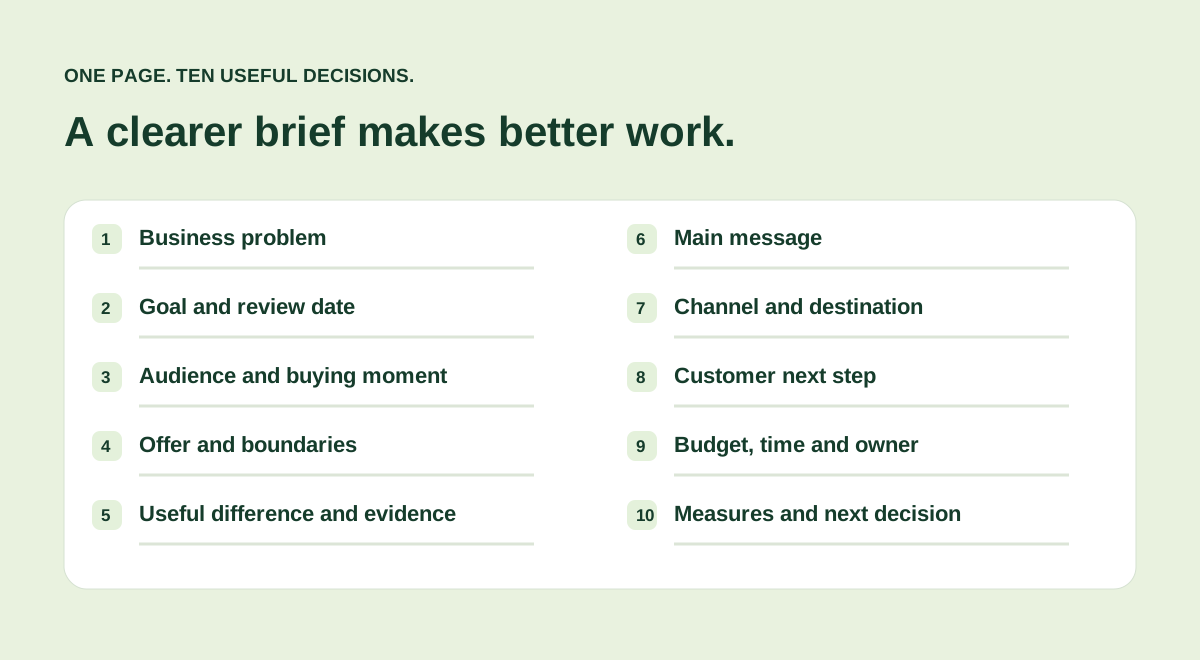
Separate your brief into three layers: stable business context, current offer facts and this piece’s job. Stable context includes what you sell and how you normally speak. Offer facts include the current price, dates and availability. The job states who should do what after reading.
OpenAI’s prompt engineering documentation describes instructions, examples and relevant context as useful prompt components. The three-layer brief below is our editorial way of applying that idea to small-business marketing.
Five details that change the draft
| Replace this vague input | With a useful instruction |
|---|---|
| “Target busy people.” | “Address office workers nearby who choose lunch before 10am.” |
| “Make us sound premium.” | “Explain the material, finish and included service using the supplied specifications.” |
| “Use a friendly voice.” | “Use short sentences and a helpful invitation; here is a sentence our owner would say.” |
| “Add urgency.” | “Orders close at 10am because the kitchen prepares the confirmed quantity.” |
| “Get more leads.” | “Ask suitable customers to send their postcode, service needed and preferred date.” |
Specificity is not the same as adding adjectives. “Fresh, delicious, irresistible” remains vague. “Includes iced tea; collection only” changes the purchase decision. Put the detail that answers the customer’s main hesitation near the start.
A short voice example is also more useful than a string of personality labels. Supply “Tell us your date and we’ll check the available times” if that sounds like your team. Explain why: direct, warm and clear about what happens next.
Two before-and-after examples, with the edits explained
These original examples use fictional businesses and offers.
Salon before: “Discover your best self with our luxurious hair services. Our passionate team is ready to transform your look. Book today!”
Salon after: “Have a free Tuesday afternoon? Book a wash and cut with our junior stylist for RM65 at Ruang Hair, Subang Jaya. Tuesday appointments run from 2–5pm; colouring and treatments are separate. Message your preferred Tuesday and time, and we’ll confirm an available slot.”
Why the edit works: The opening names a situation the reader can recognise. The stylist level and price define the offer. The final sentence makes the booking process clear. “Transform your look” promised a feeling; this version explains what the appointment contains.
B2B service before: “Discover seamless IT solutions that empower your business to thrive. Get in touch with our experts for a tailored solution.”
B2B service after: “Replacing laptops for an office with 5–25 devices? Meja IT’s free 20-minute discovery call helps scope the rollout. Bring your device count, office location and target date. Request a call through our form; we’ll reply with the next available times.”
Why the edit works: The opening helps the right buyer recognise themselves. A defined call replaces an undefined “solution”. The preparation details reduce the work needed to begin. Neither rewrite needs invented testimonials or a claim to be the best.
A reusable prompt you can copy
Use this with the one-page marketing brief. Replace every bracketed item. Paste the relevant offer facts rather than assuming a tool has read your website.
Help me draft one marketing message for this business.
Business context: [What we sell, location or service area, and the customers we serve.]
This message’s job: [One business problem and one customer action.]
Audience and moment: [Who is reading and what they are trying to get done.]
Confirmed offer facts: [Product or service, current price, dates, availability, inclusions, exclusions and fulfilment details.]
Useful difference: [One relevant advantage and the evidence we can show.]
Customer hesitation: [The question this message should answer.]
Channel and length: [Where it will appear and a practical word limit.]
Next step: [Action, working destination and what the customer must provide.]
Voice example: [One sentence that sounds like us, and why.]Use only supplied facts. If an essential fact is missing, ask up to three short questions before drafting. Do not invent prices, discounts, deadlines, reviews, product benefits or business results.
Write two versions: one led by the customer’s situation, one led by the offer. Keep the offer and next step consistent. Prefer concrete details to broad praise. After each version, explain the main editorial choice in one sentence and flag any statement I need to verify.
Two versions are enough to make a meaningful choice. Select a direction before requesting ten channel adaptations. Otherwise, you can create a large pile of material built around an offer you have not settled.
Edit with a substitution test
Read the draft and replace your business name with a competitor’s. If everything still works, underline the interchangeable sentences. Ask which customer question each sentence answers. Delete empty praise or replace it with a relevant fact.
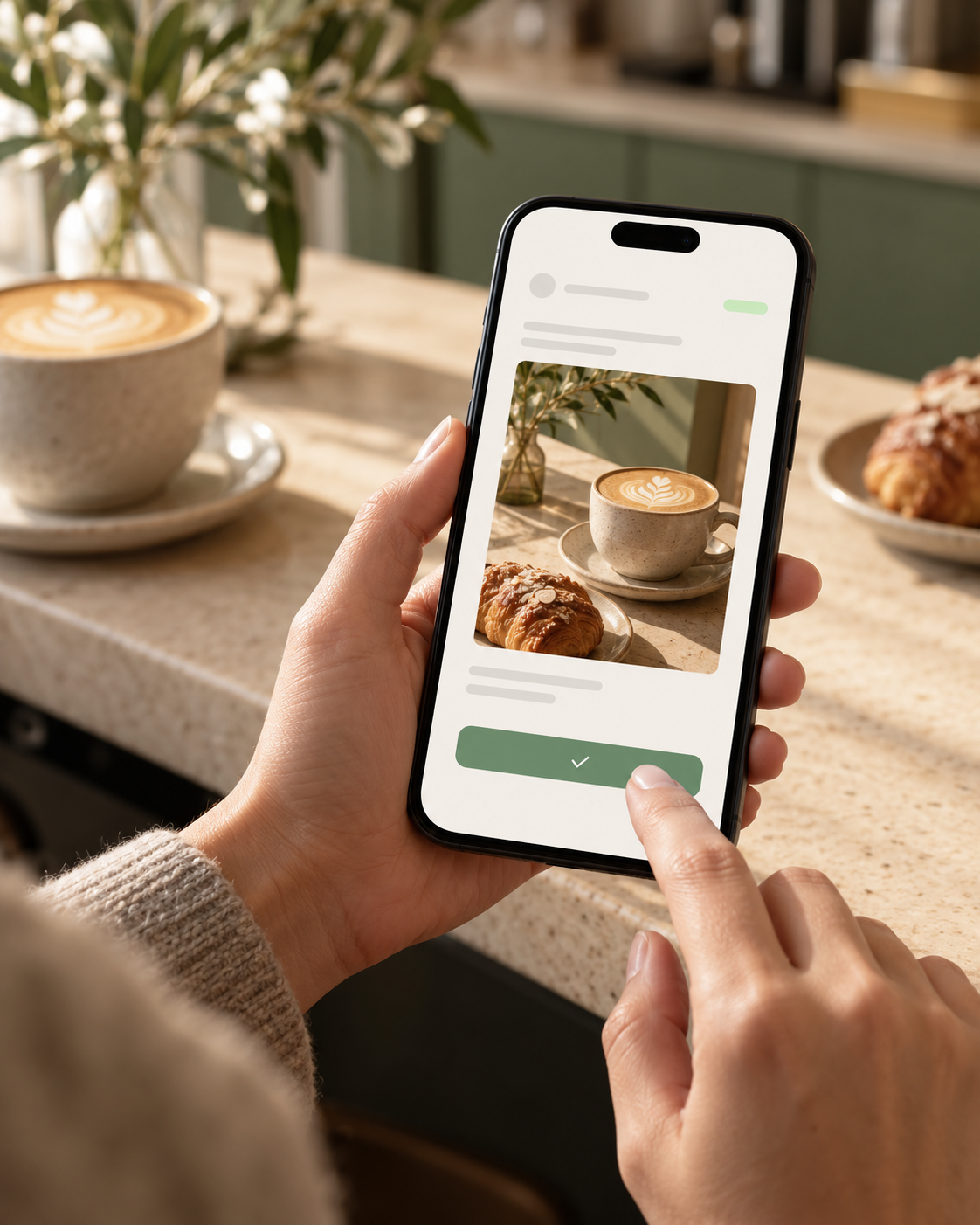
Then read the headline, visual and next step together. A photo of a full meal beside copy advertising only a drink can change what someone thinks is included. Check the complete message rather than approving the caption in isolation.
For website content, Google’s generative AI content guidance calls for human fact-checking and useful content; producing many pages without added value can violate its spam policies. Our editing test focuses that review on the customer’s decision.
Give the next draft a better starting point
Save the edits that matter: the phrase you removed, the missing fact you added, and the voice example you preferred. Put recurring context in My Business; use Kairos to explore the campaign question and Content Studio for copy and visual editing. Keep current offer details beside the work.
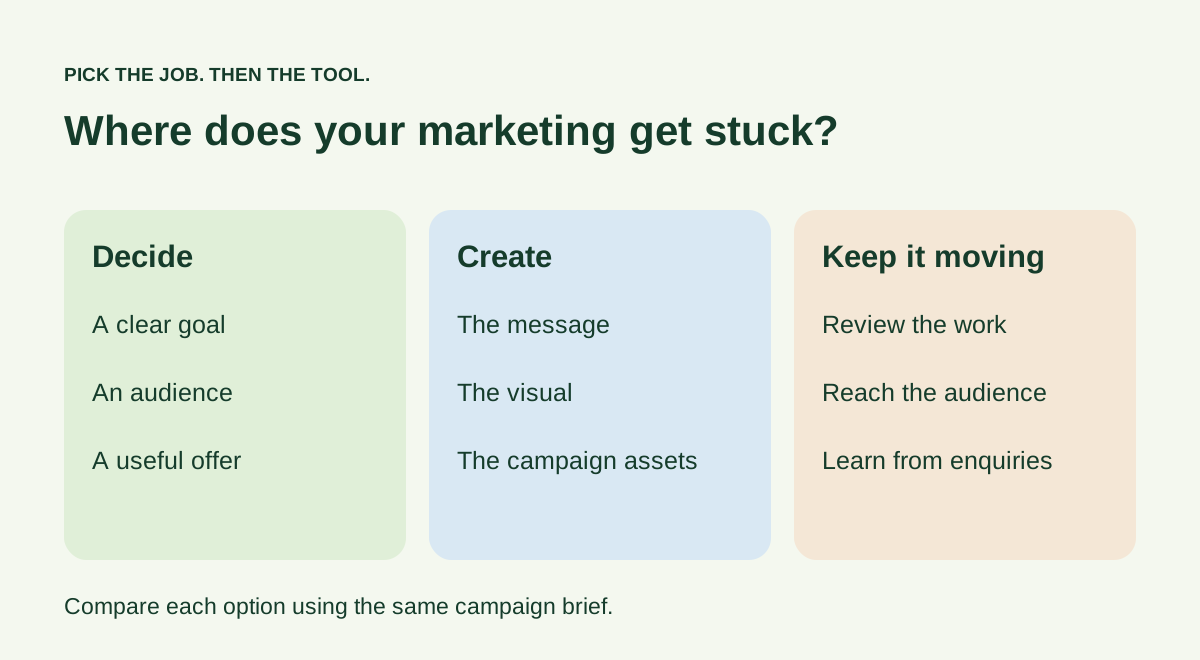
If your difficulty is choosing the right software, our AI marketing tools guide compares tools by the job you need done. If the direction is already clear, explore the AI CMO sample workflow and bring a focused brief to your next campaign.
Prepared by Upside. Sources are linked alongside the claims they support.
 Tools & decisions · 6 min read
 Marketing planning · 6 min read
 Search & visibility · 6 min read